

Commercial doors get spec'd, not just picked off a shelf. Put the wrong door on a high-traffic opening and it doesn't just cost you on the install, it costs you every time it fails, in downtime and emergency-service calls, on the busiest day of your week. We've been installing and servicing commercial and industrial doors on the Central Coast since 1996, everything from a single roll-up on a Hollister shop to high-cycle doors at Salinas Valley food plants. This is the guide I'd give a facility manager or a GC deciding what to put on a new or replacement opening.
Sectional vs. rolling steel: start here
The first fork in the road is the door type, and it comes down to your building.
Sectional doors are panelized doors that travel up and back along horizontal tracks, the same basic idea as a residential door but built heavier. They're the common choice when you've got the headroom and ceiling space for the tracks, and they take insulation well. Good for warehouses, dealerships, and conditioned spaces.
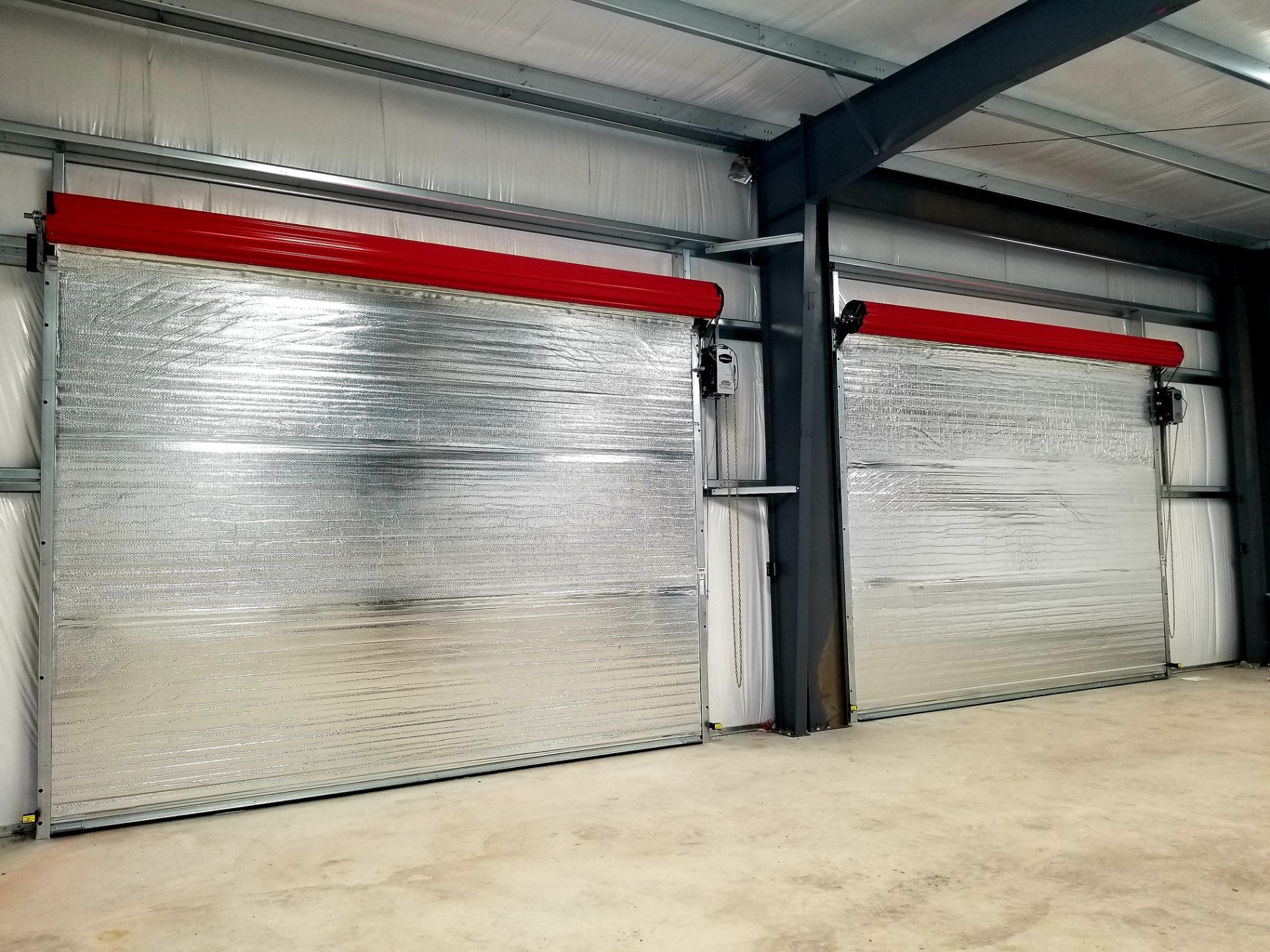
Rolling-steel doors coil up into a barrel above the opening. They're the right call when ceiling space is tight, when the wall is masonry or tilt-up, or when the door needs to shrug off forklift bumps and hard use. You see them on self-storage, industrial buildings, and anywhere a sectional door would be in the way.
Neither one is "better." The building tells you which one you need, and getting that wrong is expensive to undo.
Cycle ratings matter more than people think
Every commercial door and spring system has a cycle rating, the manufacturer's expected service life in open-and-close cycles. This is the single most important number most buyers ignore.
- Standard residential springs: about 10,000 cycles
- Light commercial: 25,000 to 50,000
- Heavy commercial: 100,000 or more
- High-cycle: 500,000 and up
Here's why it matters. A door at a distribution dock that opens 30 times a day runs over 10,000 cycles in a single year. Put a standard spring on that opening and you'll be replacing it inside two years, over and over. Size the door and springs to how many cycles the opening actually runs, and you pay a little more up front and a lot less over the life of the door. When we quote a commercial opening, the first thing we ask is how many times a day it runs.
Insulation: only where it earns its keep
Insulated commercial doors, with polyurethane or polystyrene cores in the R-12 to R-18 range, are the right call for any conditioned space, cold storage, climate-controlled manufacturing, or distribution with sensitive product. The energy savings pay the difference back fast. For an unheated warehouse or a barn, an uninsulated door is fine and meaningfully cheaper. Don't pay for R-value you're not using, and don't skip it where the building is conditioned.
Fire-rated rolling doors and NFPA 80
If your building has openings in fire-rated walls, you likely need fire-rated rolling doors. These drop closed automatically when the fire-alarm system signals a fire, and they're not optional where code requires them. The part a lot of owners miss: NFPA 80 requires annual drop testing, a documented test that the door actually closes correctly under fire conditions, with the results on file. If you've got fire doors and you can't produce drop-test records, you're out of compliance, and that shows up on inspections. We perform NFPA 80 drop tests, document them, and reset the door, so you stay covered.
Operator sizing: the mistake we see most
The operator, the motor that runs the door, has to be sized to the door's weight, its cycle rate, and its duty cycle. An undersized operator on a high-cycle door is the number one cause of premature operator failure we see in the field.
- Trolley operators run sectional doors and are the common commercial choice.
- Jackshaft operators mount on the torsion shaft and free up your ceiling, good for tight or high-traffic bays.
- Hoist operators run rolling-steel doors.
Three-phase where the building has it, since three-phase operators are smoother, last longer, and have better torque at start. We spec LiftMaster Commercial and equivalent operators sized to the actual door, not to whatever's cheapest on the shelf. Get this right and the operator quietly does its job for years. Get it wrong and it becomes a line item on your maintenance budget.
Who you buy it from matters as much as what you buy
A commercial door is only as good as the crew that spec'd, installed, and maintains it. Ask whether the company holds the right license (we're California C-61/D-28, which covers residential, commercial, and industrial), whether they'll drop-test your fire doors and document it, and whether they offer scheduled maintenance with written reports. Unplanned commercial downtime costs far more than a maintenance contract does, which is exactly why we push property managers toward a schedule instead of waiting for the door to fail on a Tuesday afternoon.
The bottom line
Choosing a commercial garage door comes down to five honest questions: sectional or rolling steel for your building, how many cycles a day the opening runs, whether the space is conditioned, whether the opening is fire-rated, and what operator the door actually needs. Answer those correctly and you get a door that runs for years. Guess at them and you get a door that becomes a recurring problem.
If you've got a commercial or industrial opening to spec on the Central Coast or in the Salinas Valley, walk us through how the building actually gets used and we'll spec a system that holds up. Start with our commercial overhead doors and industrial doors and motors pages, or request a commercial estimate.
Frequently asked questions
- What's the difference between sectional and rolling-steel commercial doors? Sectional doors travel up along ceiling tracks and take insulation well; rolling-steel doors coil into a barrel above the opening and are better for tight ceilings, masonry walls, and heavy-duty use.
- Do commercial fire doors really need annual testing? Yes. NFPA 80 requires annual drop testing on fire-rated rolling doors, documented and on file. We perform and document the test and reset the door.
- How do I know what operator my commercial door needs? It's sized to the door weight, the cycles per day, and whether you have three-phase power. We size the operator to the actual opening; an undersized one is the most common cause of early failure.